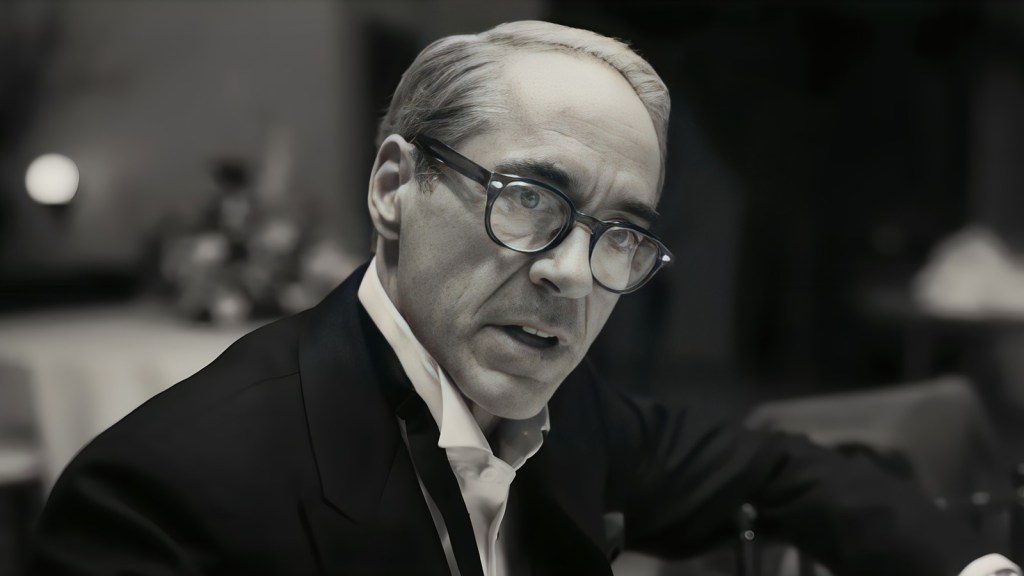
☢️💣 If you watched Oppenheimer, you'll recognise this as Lewis Strauss, the film's antagonist.
— Keith Woods (@KeithWoodsYT) February 8, 2024
Strauss is depicted as a fierce Cold Warrior who casts suspicion on Oppenheimer for sympathy to the Soviet Union.
But Strauss held a dual loyalty of his own. 🇮🇱
1/11 🧵 pic.twitter.com/rFgmxbeUPc
2/11 Strauss was the architect of American nuclear policies in the 1950s.
— Keith Woods (@KeithWoodsYT) February 8, 2024
Strauss left a career as an investment banker on Wall Street to lead the Atomic Energy Commission – an agency set up to be custodian of America’s nuclear materials. ☢️ pic.twitter.com/E3yOjzsBXa
3/11 Strauss was a conservative and a staunch anti-communist. 🇺🇸
— Keith Woods (@KeithWoodsYT) February 8, 2024
He is now most remembered for his successful fight to strip Robert J. Oppenheimer of his security clearance. This conflict was the focus of Chrospher Nolan's film. pic.twitter.com/AugETaP6SL
4/11 One theme of the film is the different relationships Strauss and Oppenheimer have to their Jewish identities. ✡️
— Keith Woods (@KeithWoodsYT) February 8, 2024
Strauss, grandson of Jewish immigrants, was the picture of an assimilated Jew, insisting people pronounce his surname as the more English sounding "Straws". pic.twitter.com/HhzAvUiStk
5/11 Though he kept it private, Strauss' Jewishness was central to his identity.
— Keith Woods (@KeithWoodsYT) February 8, 2024
Strauss was a leader from 1938 of the largest Reform synagogue in New York City.
He wrote of his great guilt at not doing enough to stop the rise of the Nazis, and held onto a disdain for Germans. pic.twitter.com/XKuPLu8ZKn
6/11 Though Strauss was originally an opponent of Zionism, he became more sympathetic through his lifetime, before finally visiting Israel in 1964. 🇮🇱 pic.twitter.com/PtTdBqLvvz
— Keith Woods (@KeithWoodsYT) February 8, 2024
7/11 When Strauss left the AEC in 1958, he did not inform his successor – John McCone – of the intelligence he knew about Israel's nuclear weapons program.
— Keith Woods (@KeithWoodsYT) February 8, 2024
According to Seymour Hersh, this was because "as a Jew with deep feelings about the Holocaust, he approved of it". pic.twitter.com/xr9l5gan6V
8/11 Strauss befriended his Israeli counterpart Ernst David Bergmann – the father of the Israeli nuclear program.
— Keith Woods (@KeithWoodsYT) February 8, 2024
The Director for Advanced Studies at Princeton soon realised he was working on an Israeli nuclear bomb, and was surprised to discover Strauss privately supported it. pic.twitter.com/HT2GxWBFDZ
9/11 🔎 In 1958, the CIA presented surveillance photos of Israel's nuclear site at Dimona to Eisenhower and Strauss, but neither reacted or took action to stop it. pic.twitter.com/L3egnISTpw
— Keith Woods (@KeithWoodsYT) February 8, 2024
10/11 Seymour Hersh, in his book The Samson Option, concludes that Strauss likely kept quiet about Israel's nuclear program because he held dual loyalty to Israel. 🇮🇱 pic.twitter.com/EdFe0IClS4
— Keith Woods (@KeithWoodsYT) February 8, 2024
11/11 Strauss, who ruthlessly pursued his fellow Jew Oppenheimer for his lack of loyalty, had finally wavered in his duty – siding with Israel over the United States. pic.twitter.com/JCwSSFnnjl
— Keith Woods (@KeithWoodsYT) February 8, 2024
Share this:
- Share on Telegram (Opens in new window) Telegram
- Share on Facebook (Opens in new window) Facebook
- Share on LinkedIn (Opens in new window) LinkedIn
- Share on Reddit (Opens in new window) Reddit
- Share on Tumblr (Opens in new window) Tumblr
- Share on Pinterest (Opens in new window) Pinterest
- Share on WhatsApp (Opens in new window) WhatsApp
- Share on Mastodon (Opens in new window) Mastodon
- Share on Nextdoor (Opens in new window) Nextdoor
- Share on X (Opens in new window) X
- Email a link to a friend (Opens in new window) Email
 Zoomernation news
Leave a comment